
Online Eye Doctor Consultation: Everything You Need to Know
"Patients rarely tell me they want another examination. More often, they tell me they simply want to understand what is happening to their eyes."
- Dr. JD Ferwerda
If you are considering an online eye doctor consultation, you may be wondering whether an ophthalmologist can genuinely help without examining your eyes in person. It is a sensible question. Eye care is closely associated with slit lamps, dilating drops, pressure measurements, and sophisticated imaging. Some eye problems cannot be assessed safely without those tools.
But an online eye doctor consultation is not an attempt to reproduce a complete eye examination through a webcam. It is a structured medical discussion that brings together your symptoms, medical history, previous eye examinations, scans, reports, and concerns. When the right information is available, an experienced ophthalmologist can often explain what the findings mean, offer an independent perspective, and help you decide what to do next.
The honest answer is therefore not that every eye problem can be managed online. It is that eye online consultation can be extremely useful for the right question, provided its limits are respected.
Important: An online consultation is not an emergency service. Sudden loss of vision, severe eye pain, a serious eye injury or chemical splash, many new floaters or flashes, a curtain or shadow in your vision, or sudden double vision with neurological symptoms requires urgent local medical assessment.
What is an online eye doctor consultation?
An online eye doctor consultation is a private remote consultation with an ophthalmologist. It may include a live video conversation and the secure review of medical information that you provide before the appointment.
That information may include:
OCT scans
Retinal or optic-nerve photographs
Visual-field test results
Corneal topography or optical biometry
Glasses prescriptions and refraction results
Referral letters and clinic notes
Medication lists
Previous surgical reports
A timeline of your symptoms and treatment
The webcam itself usually contributes little to a detailed examination of the inside of the eye. The real value comes from combining your story with existing clinical evidence. Modern ophthalmology produces a great deal of digital information, and careful review can answer questions that may not have been fully addressed during a busy clinic visit.
During an eye doctor online consultation, the ophthalmologist listens to what has happened, reviews the records in context, explains the likely significance of the findings, and considers whether the evidence is sufficient for useful guidance. If it is not sufficient, the correct outcome may be a recommendation for a particular test or a prompt in-person examination.

Is an online consultation the same as an online eye test?
No. These terms are sometimes used as though they mean the same thing, but they describe different services.
An online vision test may estimate aspects of visual acuity or refraction, but it does not provide a comprehensive medical eye examination. An online ophthalmology consultation is a clinical discussion with a medical eye specialist about your symptoms, diagnosis, investigations, treatment options, and next steps. Unlike general information or an informal chat, it considers the records you provide, subject to the limits and regulations of remote care.
What can an online ophthalmologist help with?
Patients usually seek an online eye doctor consultation for one or more of four reasons: explanation, review, preparation, or direction.
Understanding a diagnosis
Medical words can be difficult to absorb, particularly when you receive unexpected news. You may leave a clinic knowing the name of a condition but not what it means, how serious it is, whether it is stable, or what signs should prompt earlier review.
An online eye doctor consultation creates protected time to revisit the diagnosis in plain language. The aim is not only to tell you what a scan shows, but to explain how the finding relates to your symptoms, your risks, and the questions you need to ask next.
Reviewing scans and reports
OCT scans, retinal photographs, visual fields, and other investigations often contain valuable information. Their meaning depends on image quality, changes over time, the reason the test was performed, and the rest of the clinical picture.
An ophthalmologist may be able to review these records with you and explain their significance. A single image is not always enough to confirm a diagnosis, and remote review cannot replace missing examination findings. However, it can clarify what is already known and identify gaps in the available information.
Obtaining an independent second opinion
A second opinion does not automatically mean that the first doctor was wrong. Many patients simply want to make sure they understand the recommendation before starting long-term treatment or proceeding with surgery.
An online eye specialist consultation may help you review the reasoning behind a proposed plan, discuss possible benefits and risks, and prepare more focused questions for your treating ophthalmologist. Sometimes the independent opinion supports the existing plan. Sometimes it suggests that further information would be useful. Either result can make the next decision clearer.
Deciding on the next step
Not every consultation ends with a diagnosis. Sometimes the most useful outcome is knowing what needs to happen next: routine follow-up, a specific investigation, discussion with a subspecialist, or urgent examination.
Good remote care includes recognizing uncertainty. If the evidence is incomplete, the ophthalmologist should explain what cannot be concluded and why an in-person examination or additional test is needed.
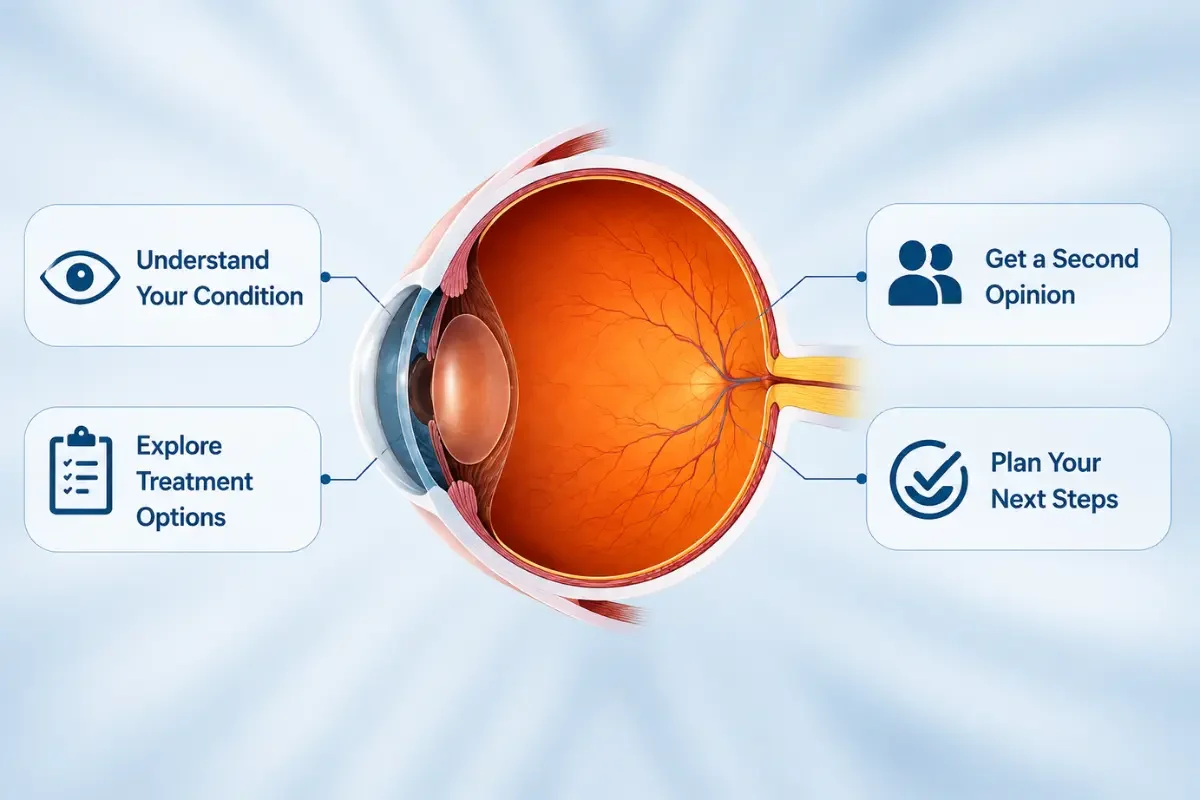
Which eye conditions can often be discussed online?
Whether remote advice is appropriate depends less on the name of the condition than on the question being asked and the information available. A stable diagnosis supported by recent tests may be suitable for detailed discussion. A new, rapidly changing, painful, or unexplained symptom may require examination first.
Cataracts and cataract-surgery decisions
People diagnosed with cataracts often have practical questions. Is surgery needed now? What are the likely benefits? What are the limitations of different intraocular lenses? What factors should be discussed with the surgeon?
An online eye doctor consultation can help you understand the diagnosis and organize the questions that matter to you. It cannot perform the measurements needed to select an implant, examine the retina, or decide on surgical suitability without the relevant local tests.
Glaucoma and ocular hypertension
Glaucoma decisions are not based on eye pressure alone. Ophthalmologists also consider the optic nerve, OCT imaging, visual fields, corneal measurements, risk factors, treatment history, and change over time.
If these records are available, a remote review may help explain whether the findings appear consistent, why follow-up is needed, and which questions to discuss with your local glaucoma specialist. Pressure measurement and direct examination still need to take place locally.
Retinal and macular conditions
Many retinal conditions rely heavily on imaging. Age-related macular degeneration, diabetic retinopathy, epiretinal membrane, macular hole, retinal vein occlusion, and other macular disorders may be discussed using OCT scans and retinal photographs, together with the clinical history.
Remote review may clarify terminology, compare reports, or help you understand a proposed treatment or monitoring schedule. New distortion, a sudden change in vision, flashes, many new floaters, or a shadow in the visual field may require urgent dilated examination rather than a scheduled online appointment.
Diabetic eye disease
Retinal screening may detect changes before you notice symptoms. An online discussion can help explain photographs or OCT findings, the difference between stages of diabetic retinopathy, and why a particular follow-up or treatment has been recommended.
It does not replace regular diabetic eye screening, pupil dilation, or treatment by a local ophthalmology team when those are indicated.
Myopia and myopia control
Parents may want to understand whether a child's short-sightedness is progressing, what measurements matter, and which evidence-based options are worth discussing locally. A consultation can review refraction history, axial-length measurements if available, family history, lifestyle, and previous recommendations.
Because children need appropriate local examinations and treatment availability varies, an online discussion should complement care from a qualified local practitioner rather than replace it.
Dry eye and long-term symptoms
Dry eye is often influenced by several factors, including eyelid health, environment, screen use, contact lenses, medication, and general health. A careful history and review of previous treatments can help organize the possible contributors and identify reasonable next questions.
Persistent pain, marked redness, light sensitivity, reduced vision, or symptoms in a contact-lens wearer may require prompt examination to exclude a more serious problem.
When is an online eye doctor consultation especially useful?
Remote specialist advice may be valuable when:
You have already had an eye examination but still have unanswered questions.
You have scans or reports and want them explained in understandable language.
You are considering surgery or a long-term treatment plan.
You have received different opinions and want an independent review.
You live far from a particular specialist or are temporarily abroad.
You want to prepare before seeing a local ophthalmologist.
You need help identifying the most relevant next investigation or specialist.
The common thread is that clinical information already exists or the main need is interpretation. If you want to consult an eye doctor online about a new problem, remote advice may help with triage but may not establish the diagnosis.
What an online consultation cannot do
Responsible online medicine depends on being clear about limitations. An online eye doctor consultation cannot provide a complete slit-lamp examination, dilated retinal examination, reliable eye-pressure measurement, corneal staining, gonioscopy, or all of the measurements used to plan surgery.
It may also be limited when:
Images are missing, blurred, incomplete, or too old to answer the question.
The reports do not include the underlying scans or test data.
Symptoms are new, severe, or changing quickly.
The diagnosis depends on examination findings that cannot be observed remotely.
Language, hearing, technology, or connection problems prevent safe communication.
Local prescribing, licensing, or insurance rules restrict what can be provided.
An online consultation should not promise certainty where none is possible. It should distinguish between confirmed information, a possible interpretation, and questions that remain open.
Online eye doctor consultation vs. in-person eye examination
| Online consultation may be suitable for | In-person examination is needed for |
|---|---|
| Explaining an existing diagnosis | Direct examination of the front or back of the eye |
| Reviewing available scans and reports | Measuring eye pressure or performing new tests |
| Independent second opinions | Investigating many new or unexplained symptoms |
| Discussing treatment choices | Treating an injury, infection, or emergency |
| Preparing questions before surgery | Surgical measurements and procedure-specific assessment |
| Identifying information or tests that may be missing | Immediate treatment or procedures |
The two forms of care are partners, not competitors. A useful online consultation often depends on good testing performed locally. In turn, clearer understanding can help you make better use of the time you spend with your local eye-care team.
How does an online eye doctor consultation work?
1. Decide what you want to understand
Before you book online eye consultation, write down your main question. For example: "Why has surgery been recommended?" "Does my OCT show progression?" or "Which additional test would help clarify the diagnosis?"
A focused question helps the ophthalmologist determine whether remote review is likely to be useful and which records are needed.
2. Choose the appropriate appointment length
A straightforward question with a small number of records may take less time than a complex history involving both eyes, several diagnoses, or many years of imaging. Select the appointment type that fits the complexity described by the service. If you are unsure, contact the service before you book an online eye consultation.
3. Upload your information securely
Send relevant records through the secure method provided. Avoid ordinary social-media messaging for sensitive medical documents. Include the dates and identify which eye each image or report concerns whenever possible.
Do not worry if you do not have every document. Send what is available and explain what may be missing. The ophthalmologist can then tell you whether the material is sufficient or whether additional information would improve the consultation.
4. Attend the video consultation
Choose a quiet, well-lit place with a stable internet connection. Have your glasses, medication list, and questions nearby. If a family member or interpreter will join, arrange this in advance and make sure you are comfortable sharing medical information in their presence.
The consultation usually begins with your story: what you have noticed, when it began, what examinations were performed, what you were told, and what concerns you most. The doctor can then review the available information with you and explain the options and limitations.
5. Leave with a clear plan
At the end of your online eye doctor consultation, you should understand what has been discussed, what remains uncertain, and the recommended next step. Depending on the circumstances, that may be reassurance, routine local follow-up, a specific investigation, a discussion with your treating surgeon, or urgent in-person assessment.
How to prepare for your appointment
A little preparation makes an online eye doctor consultation more useful.
Create a short timeline
Note when the problem began and whether it was sudden or gradual. Record important diagnoses, operations, injections, laser treatment, medication changes, and recent examinations. If your vision has changed, describe how and when.
Gather the most relevant records
Useful documents may include:
The most recent consultation letter
Earlier and recent OCT scans for comparison
Visual-field reports from more than one date
Retinal photographs
Eye-pressure readings with dates
Current glasses prescription
A list of eye drops and other medication
Surgical or injection records
Relevant general medical information, including diabetes or hypertension
Original images are often more informative than screenshots embedded in a letter. If you cannot obtain them, the written report may still help.
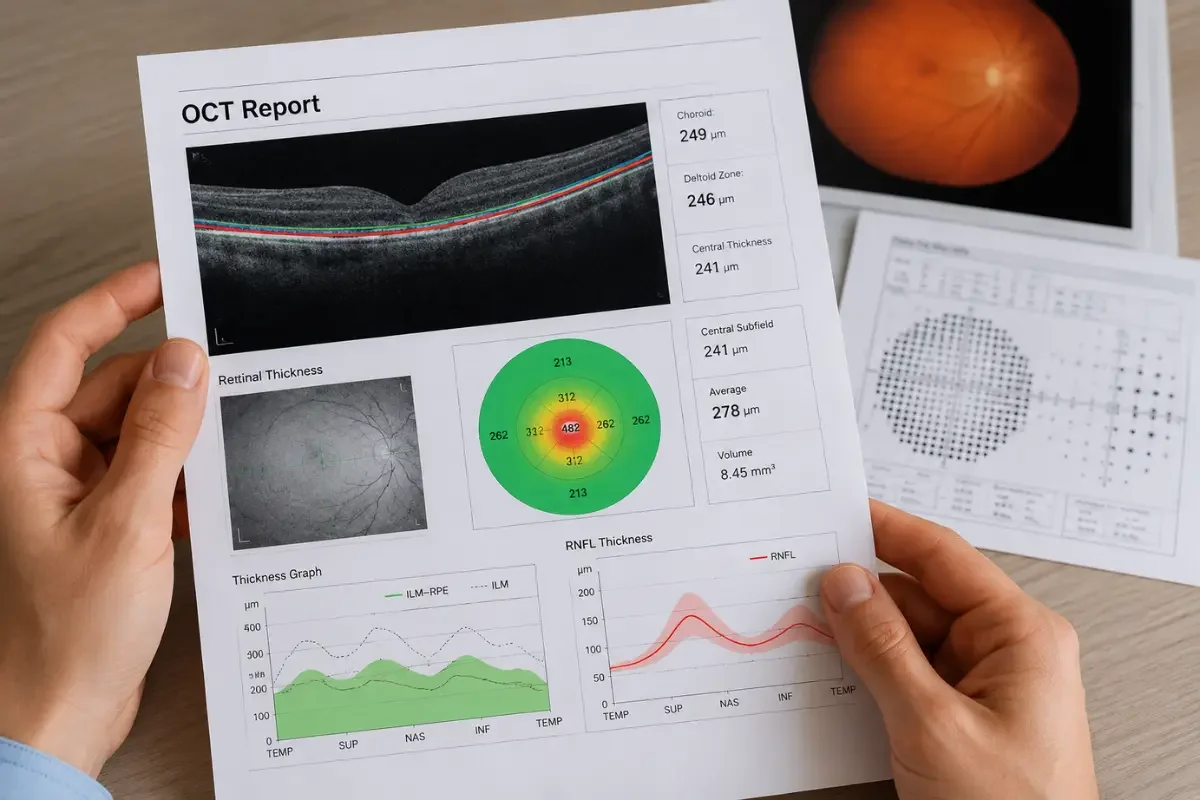
Patients can securely upload OCT scans, retinal photographs, and other eye reports before their consultation.
Prepare your questions
Patients often find it helpful to ask:
What is known with reasonable confidence?
What is still uncertain?
Do the scans and reports support the diagnosis?
Has the condition changed over time?
What are the reasonable treatment or monitoring options?
What are the benefits, limitations, and risks of each option?
What additional examination or test would be most useful?
How urgently do I need local care?
Which symptoms should make me seek help sooner?
Check the practical details
Test your camera, microphone, and internet connection. Confirm the time zone. Keep the clinic's contact details available in case the connection fails. Join a few minutes early, just as you would arrive early for an in-person appointment.
When not to wait for an online eye doctor consultation
Some symptoms need urgent local assessment because delay can threaten sight or indicate a neurological emergency. Seek urgent eye care or emergency medical care if you experience:
Sudden loss or major deterioration of vision
A sudden increase in floaters, especially with flashes of light
A curtain, veil, or dark shadow across part of your vision
Severe eye pain, particularly with redness, headache, nausea, or reduced vision
A chemical splash, penetrating injury, or high-speed impact to the eye
A painful red eye while wearing contact lenses
Sudden double vision with weakness, facial droop, speech difficulty, severe headache, or other neurological symptoms
Marked symptoms soon after eye surgery or an eye injection
Do not wait for an email reply or scheduled video appointment in these situations. Contact a local ophthalmologist, eye emergency service, or emergency department immediately. If you are unsure how urgent the problem is, seek local medical advice.
Can an ophthalmologist prescribe medication online?
Prescribing rules differ by country and depend on where the patient and doctor are located, what information is available, and whether a remote prescription would be clinically appropriate. Some conditions also require an examination before medication can be chosen safely.
The primary purpose of the ECO consultation is independent specialist advice, explanation, and guidance. If medication appears relevant, the ophthalmologist can discuss the options and may recommend that you see a local clinician who can examine you and prescribe within local regulations.
Never start, stop, or change prescribed eye medication solely because of general information on a website. Discuss changes with the clinician responsible for your care.
Can you have a consultation from another country?
Remote consultations can make specialist expertise more accessible, but professional licensing, privacy, prescribing, and insurance requirements vary between countries. Before booking, confirm that the service can accept patients from your location and understand what it can provide. You will usually still need a local professional for examinations, tests, prescriptions, and urgent care.
Privacy and secure sharing of eye records
Eye scans and reports are personal health information. Use the service's approved upload and communication systems, and check how records are stored and accessed. Confirm the name, date, and eye on each document. If another person will attend, decide whether you consent to discussing your information with them present.
Frequently asked questions
-
No. Some questions can be addressed meaningfully through the history and existing investigations, but many diagnoses require direct examination or additional testing. A responsible ophthalmologist will explain what can and cannot be concluded remotely.
-
Description text gOften, yes. OCT scans, retinal photographs, visual fields, referral letters, and surgical reports can be valuable. The usefulness of the review depends on image quality, dates, completeness, and the question you want answered.oes here
-
An online eye doctor consultation can help you understand why surgery has been advised, discuss questions about timing and lens choices, and prepare for a conversation with your surgeon. It cannot replace the local examination and measurements required for surgery.
-
No. It is designed to complement local care. Your local team remains essential for physical examinations, tests, prescriptions, procedures, emergency treatment, and ongoing monitoring.
-
Send the reports and information you have. A consultation may still be useful, particularly for understanding your history and deciding which records or tests to request. If the missing images are essential, you will be told before or during the consultation.
-
No. A standard webcam cannot provide a reliable examination of the retina. Retinal assessment may require pupil dilation, specialist lenses, and imaging. Existing high-quality retinal images can be reviewed online, but new urgent symptoms still require local examination.
-
You will be advised to seek prompt local assessment. An online service cannot provide emergency examination or treatment, so it is important to know how to reach an eye clinic or emergency department where you are.
A clearer conversation can lead to a better decision
Technology can produce extraordinarily detailed images of the eye, but images alone do not answer every question. They need to be interpreted alongside your symptoms, medical history, previous treatment, and priorities.
That is the purpose of an online eye doctor consultation: not to pretend that distance does not matter, and not to replace the ophthalmologist who examines and treats you locally, but to give you time for a careful, independent conversation. The result may be greater reassurance, a better question for your treating doctor, a clearer view of the options, or recognition that you need further assessment without delay.
If you have an existing diagnosis, scans or reports, and would like an experienced ophthalmologist to review them with you, you can book online eye consultation through Eye Consult Online with Dr. JD Ferwerda. Before booking, check the emergency guidance above and confirm that the service is available in your location.
About Dr. JD Ferwerda
Dr. JD Ferwerda is an ophthalmologist with more than 30 years of clinical and surgical experience. As an International Ophthalmology Consultant, he provides independent online consultations and second opinions for patients worldwide. His areas of experience include cataracts, glaucoma, retinal disease, age-related macular degeneration, diabetic eye disease, and myopia control.
His guiding principle is simple: the best treatment begins with understanding.
Medical disclaimer
This article provides general information and does not replace an individual medical assessment. An online consultation may not be appropriate for every person or every eye problem. If you have sudden or severe symptoms, seek urgent local medical care.
References for readers
World Health Organization. Consolidated telemedicine implementation guide. https://iris.who.int/bitstream/handle/10665/364221/9789240059184-eng.pdf
National Eye Institute. Retinal Detachment.https://www.nei.nih.gov/eye-health-information/eye-conditions-and-diseases/retinal-detachment
NHS. Eye pain. https://www.nhs.uk/symptoms/eye-pain
